Showing posts with label plague. Show all posts

Monday, January 8, 2007

Avian Flu Outbreak in Austin?

Crews collecting birds are shown on a closed off stretch of Congress Avenue in downtown Austin today.

From today's Houston Chronicle:

Downtown Austin closed after dead birds found
Copyright 2007 Houston Chronicle

AUSTIN — More than 10 blocks in downtown Austin leading up to the Capitol were shut down early today after officials found several dead birds in the area.

The area, from Cesar Chavez to Eleventh Street and some side streets, was expected to remain closed until about noon while the Austin Fire Department conducted "further precautionary testing of the area,'' police spokeswoman Toni Chovanetz said in a statement.

"Please advise individuals that work in this area not to come in until further notice,'' the statement read.

Chovanetz would not discuss details or speculate on what could have killed the birds. She said it was the first time she could remember a large swath of downtown being shut down because of dead birds.


Update:
At least one bird carcass (they were mostly grackles) is being tested locally for signs of poisoning or viral infections and others are being shipped to the Centers for Disease Control and Texas A&M University. It could be days or even weeks before the test results come back. Officials do not think bird flu is involved.

Saturday, January 6, 2007

Whip it. Whip it good.


When a problem comes along.
You must whip it.
Before the cream sits out too long.
You must whip it.
When something's going wrong.
You must whip it.

-Devo
(click for video)


People have whipped themselves throughout history for fun, sexual pleasure and/or religious reasons, but it wasn’t until the Black Death that it became really popular. The flagellant movement – a radical Christian movement that involved mortification of the flesh as a demonstration of piety - gained momentum because many believed that the plague was a punishment sent down by God. Flagellants believed that if they demonstrated their devotion to God through their pain, they might bring an end to the greater suffering of the living victims of the plague.

Groups of flagellants would spring up spontaneously in Europe, and wander from town to town for 33 1/2 days (1 day for each year Jesus was alive), never spending more than one night in any one place. Each flagellant would carry a scourge, a heavy leather thong tipped with metal spikes or studs, to whip themselves and others with. The ritual began with the reading of a letter, claimed to have been delivered by an angel and justifying the Flagellants' activities. Next the followers would fall to their knees and scourge themselves, gesturing with their free hand to indicate their sin and striking themselves rhythmically to songs, known as Geisslerlieder, until blood flowed. Sometimes women would soak up the blood in rags and treat it as a holy relic, dabbing the blood on their eyes.

The procession would usually start small, and grow as they passed through towns, gaining new members in each new place. It wasn’t uncommon for a procession to grow to 5,000 or even 10,000 people. This is despite the harsh requirements for new recruits. New entrants had to make a confession of all sins since the age of seven and then flagellate themselves for thirty-three and a half days. Each member also vowed never to bathe, shave, sleep in a bed, change their clothing or converse in any way with members of the opposite sex. They also had to pay a fee.

Sources: Catholic Encyclopedia, History Guide, Wikipedia

Friday, January 5, 2007

Frighted: 23
Plague: 68,596


Bills of mortality like this one (click image to enlarge) were started in 1592 after an outbreak of plague to warn the townspeople of the mounting death count. From 1603 on they were distributed on a weekly basis.

Source: Wikipedia

Wednesday, January 3, 2007

Pocket-sized plague killer


Sure, your cell phone sends email, takes photos, keeps all your appointments and even calls people. But does it kill 99.99% of E-Coli, staphylococcus, salmonella, and germs that cause the flu and the common cold? Didn't think so. What you need is a Handheld Germ-Eliminating Light.

It uses the same kind of UV technology found in hospitals to sterilize surgical instruments, allowing you to disinfect workplace keyboards or telephones, as well as germ breedinggrounds such as toothbrushes and cutting boards. It disinfects surfaces in 10 seconds and even signals you when sterilization is complete. It fits easily in a shirt pocket , and looks like it would fit a standard size ipod cozy, too. Just $80 to keep the germs at bay. If only you could flood your entire house with this light.

Monday, December 25, 2006

Stupid global warming

According to the BBC, warming climate changes could lead to more outbreaks of bubonic plague among human populations. Great.

Attack of the Fleas


Wayne's been using this break between plays to do some much-needed cleaning and organizing downstairs at the Axiom. He must have disturbed a nest of fleas or something, because all of a sudden, they're everywhere. And I mean EVERYWHERE. So Friday he bought two gallons of industrial strength flea killer, soaked the Axiom with it until the stench of floral scented chemicals was overwhelming, and we all left early. The fleas should all be quite dead after we return from the holiday break on January 2.

This development is particularly disturbing after reading up on the role of the flea in speading the plague. Disturbing enough to keep one up at night. Especially when you go on to research how fleas can be intentionally used as a means of biological warfare. In the middle ages, cadavers infected with plague fleas were catapulted into nemy cities. In the 1940's, the Japanese airdropped paper packets of plague fleas on Chinese territories, and their bites killed hundreds. Japan also developed a specialized bomb, the Type 50 Uji, which could hold up to about 30,000 plague fleas. Intended to burst at an altitude of 660 to 980 feet above ground level, field trials at Anta, Manchuria, concluded that 80 percent of the fleas survived dissemination and that coverage was best under conditions with high wind. Also during WWII, Canada (yes, Canada) worked to create a colony of fleas for use in combination with both plague and murine typhus. In the United States, the plague flea concept was competing against the use of mosquitoes, flies, ticks, and lice. Of these concepts, the United States put most of its energies behind weaponizing yellow fever in combination with the Aedes aegypti mosquito. Who knows what our governments would be capable of now.

FUN FLEA FACTS
  • The Ctenocephalides felis flea, (the kind of flea you find on your dog or cat), can jump the equivalent of the Eiffel Tower and has an acceleration 50 times higher than a space shuttle.
  • 15th century ladies wore fur to trap fleas.
  • People in the 17th century wore cylinder flea traps around their necks. Scented substances or rags soaked in blood were inserted in the traps to attract fleas.
  • Americans spend one billion dollars a year to find a new molecule which will eliminate fleas.
  • The National History Museum has over 270,000 specimens of fleas in its Lord Rothschild collection
  • It was once believed that there was a hormonal relation between women and fleas.

The splendid flea image above, btw, was drawn by Robert Hooke in his famous Micrographia. Robert Hooke was very colorfully depicted in Neal Stephenson's Quicksilver (The Baroque Cycle, Vol. 1) - if you haven't read it, I highly recommend it.
Wednesday, December 20, 2006

Plague Doctors: then and now

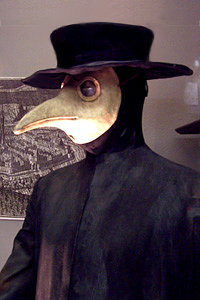
During the Black Death, plague doctors would wear a very distinctive, funny-looking costume.

Most of these "doctors" were actually unqualified volunteers- the real doctors fled the cities in the early stages of the plague. Their outfit consisted of a broad rimmed hat, worn low on the head. Underneath the hat, plague doctors wore a mask which completely covered the head, and was gathered in at the neck for extra protection. The mask had crystal lenses over the eyes to protect the wearer, and a long beak which was stuffed with spices or herbs to purify the air that the doctor breathed. Some historians have hypothesized that the mask's beak symbolized a prevailing belief of the period that the plague was carried by birds. The plague doctor would wear a full length gown made of thick material which was then covered with wax. He would also wear leather gloves, leather boots, and underneath the gown, leather breeches. He would always carry a long wooden stick to push away plague victims who attempted to get too close, and to touch the garments of the diseased.

For the most part, plague doctors didn't even attempt to treat those afflicted with the plague. They knew it was useless. The most they could hope for was to identify the sick without becoming infected themselves. When they did attept treatments, they would use leeches (didn't work), give the victim hot drinks (didn't work), give the victim a strong does of laxatives (sometimes quickened death because of dehydration), or they would coat the victim with mercury and place them in an oven. This last "treatment" would often kill the victim - mercury is poisonous, and the heat from the oven would cause serious burns.

Modern day doctors who are called in to treat deathly infectious diseases also wear elaborate costumes to protect themselves from the sick. They wear Hazmat suits, which are just as terrifying to modern people as the plague doctor uniform was during the Black Death.

Hazmat (short for Hazardous Materials) gear (or "bunny suits", as they are sometimes called) protect against all forms of chemicals: solids, liquids, and gasses/vapors.

Hazmat suits are hot - it is not uncommon for the environment inside the suit to be 20-30°F (11-17°C) hotter than the ambient temperature, and 100% humidity, within minutes of sealing up the suit. Because of this, medical monitoring is required before and after working in these suits. Hazmat gear will usually be worn in several layers, making it even less comfortable to wear. These layers are taped up at the ankle and wrist, so that there are no gaps for nasty things to enter. After using this equipment in a hazardous environment, the wearer will have to be decontaminated before removing the suit.

The first layer is a one-piece jumpsuit which seals snuggly at the ankles, wrists, and neck, giving fire protection.

The next layer of defense is a Tyvek suit. This disposable suit provides a layer that is impermeable to most chemicals. In addition, the wearer wears an SCBA, and carries a voice-actuated radio, because once sealed inside the outer suit, there is no way to reach any of this equipment. Tyvek booties cover boots, and an inner pair of Silver-Shield chemical protective gloves is put on over latex surgical gloves. Some wearers also carry a knife, in the event that they have to get out of the suit quickly in an emergency. The suit is too heavy to tear through, and would have to be cut from the inside.

The next layer is completely sealed and has a one way (exhaust) pressure bleed valve to vent the wearer's expelled air. Even with this valve, the suit tends to blow up like a balloon.

The final layer is a flash suit, worn to protect the wearer from fire and explosions. This outer layer would be worn in the unlikely event that the wearer had to enter an explosive atmosphere. This is a situation which would normally be avoided at all cost, except when human life is in danger. Some Hazmat suits have flash protection built in, but that makes them even more expensive.

If everything is being worn, the wearer has five layers of hand protection, five layers of foot protection, and is looking through three layers of protective windows. Needless to say, this isn't comfortable, and one doesn't move quickly. Hazmat suits can cost anywhere from $4,000 - $10,000 each, and may need to be disposed of after a single use, depending upon what they were exposed to and how contaminated they are.

Sources: History on the Net, Wikipedia, Santa Clara County Fire Department

What is the plague, anyway?

Well, it's a disease. A really, really bad disease, caused by fleas vomiting infected blood into open wounds. Gross, no?

Plague can take many forms:
  • Bubonic plague occurs when Yersinia pestis (a bacterium) causes an inflammation of the lymph nodes, making them tender and swollen. This is the most common form of plague. Bubonic plague becomes evident three to seven days after the infection. Initial symptoms are chills, fever, diarrhea, headaches, and the swelling of the infected lymph nodes, as the bacteria replicate there. If untreated, the rate of mortality for bubonic plague is 50%.

  • Cellulocutaneous plague is a very unusual form, with Yersinia pestis causing a skin infection.

  • Pneumonic plague or pulmonic plague occurs when the lungs are infected by Yersinia pestis. It is the second most common form of plague. It may be a secondary infection, caused by bacteria spreading from the lymph nodes and reaching the lungs, but can also exist on its own, caused by inhalation of airborne bacteria. With this infection comes the possibility of person-to-person transmission through respiratory droplets. The incubation period for pneumonic plague is usually between two and four days, but can be as little as a few hours. The initial symptoms, of headache, weakness, and coughing with hemoptysis, are indistinguishable from other respiratory illnesses. Without diagnosis and treatment, the infection can be fatal in one to six days; mortality in untreated cases may be as high as 95%.

  • Meningeal plague or plague meningitis looks like meningitis at the outset. It is most common in children and is usually the end result of ineffective treatment for other forms of plague. It is highly unusual.

  • Pharyngeal plague occurs when Yersinia pestis is consumed, often through food. It can resemble tonsillitis. It is a very rare form of the plague.

  • Septicemic plague occurs when Yersinia pestis multiply in the blood. It is the third most common form of plague. It is usually associated with hunting and skinning of animals, but can also occur secondary to bubonic and pneumonic plague. This type of plague is characterized by bleeding into the skin and other organs, which creates black patches on the skin. There are bite-like bumps on the skin, commonly red and sometimes white in the center. Untreated septicemic plague is universally fatal, but early treatment with antibiotics reduces the mortality rate to 4 to 15%. People who die from this form of plague often die on the same day symptoms first appear.

  • Other forms of plague (Aliae formae pestis) include the milder forms abortive plague, asymptomatic plague and pestis minor, all three often resulting only in a mild fever and light swelling of the lymph glands, usually resolved in approximately a week if appropriate treatment is given.


Plague is primarily a disease of rodents. Infection most often occurs when a person is bitten by a rat or flea that has fed on an infected rodent. The bacteria multiply inside the flea, sticking together to form a plug that blocks its stomach and causes it to become very hungry. The flea then voraciously bites a host and continues to feed, even though it is unable to satisfy its hunger. During the feeding process, blood cannot flow into the blocked stomach, and consequently the flea vomits blood tainted with the bacteria back into the bite wound. The Bubonic plague bacterium then infects a new host, and the flea eventually dies from starvation. Any serious outbreak of plague is usually started by other disease outbreaks in rodents, or some other crash in the rodent population. During these outbreaks, infected fleas that have lost their normal hosts seek other sources of blood.

Sources: Wikipedia, Manual of Common Diseases and Parasites of Wildlife in Northern British Columbia

Sunday, December 17, 2006

Ring around the pustulant oozing sore...

Ring around the rosey
A pocketful of posies
Ashes, ashes
We all fall down


Many scholars believe that this rhyme is somehow connected to the Great Plague of London in 1665, or perhaps earlier outbreaks of bubonic plague. This is entirely unsupported by textual sources, as there is no mention of the verse, nor written evidence of its existence, before 1881.

For those that believe that the rhyme describes the plague, each line is a clear analogy. The first line illustrates the round red rash that would break out on the skin of plague victims. The second line refers to scented sachets victims would keep in their pockets to cover the odor of their sores and the dying. Others believed that such sachets would purify the air and keep them safe from the plague. Yet another hypothesis is that the modern word “posies” is derived from an Old English word for “pus”, referring to a plague victim's oozing open sores. The third line would refer to when people - alive and dead - were gathered up into piles and lit on fire in a belief that burning the diseased bodies would not allow the disease to spread. The last line is most often believed to mean “we will all die.”
Source: Wikipedia

Wednesday, December 13, 2006

Pandemics through world history

From the symptoms scattered throughout the script, the disease that kills people in Killing Game would appear to be the bubonic plague. But there have been many deadly pandemics in recorded history. The sheer numbers dead are staggering - thousands per day, in some cases. Read on for some colorful facts sure to break the ice and win you some new friends at your next cocktail party:

Peloponnesian War, 430 BC.
Typhoid fever killed a quarter of the Athenian troops and a quarter of the population over four years. This disease fatally weakened the dominance of Athens, but the sheer virulence of the disease prevented its wider spread; i.e. it killed off its hosts at a rate faster than they could spread it. The exact cause of the plague was unknown for many years; in January 2006, researchers from the University of Athens analyzed teeth recovered from a mass grave underneath the city, and confirmed the presence of bacteria responsible for typhoid.

Antonine Plague, 165–180.
Possibly smallpox brought back from the Near East; killed a quarter of those infected and up to five million in all. At the height of a second outbreak (251–266) 5,000 people a day were said to be dying in Rome.

Plague of Justinian, started 541.
The first recorded outbreak of the bubonic plague. It started in Egypt and reached Constantinople the following spring, killing (according to the Byzantine chronicler Procopius) 10,000 a day at its height and perhaps 40 percent of the city's inhabitants. It went on to eliminate up to a quarter of the human population of the eastern Mediterranean.

The Black Death, started 1300s.
Eight hundred years after the last outbreak, the bubonic plague returned to Europe. Starting in Asia, the disease reached Mediterranean and western Europe in 1348 (possibly from Italian merchants fleeing fighting in the Crimea), and killed twenty million Europeans in six years, a quarter of the total population and up to a half in the worst-affected urban areas.

Cholera
first pandemic 1816–1826. Previously restricted to the Indian subcontinent, the pandemic began in Bengal, then spread across India by 1820. It extended as far as China and the Caspian Sea before receding.
The second pandemic (1829–1851) reached Europe, London in 1832, Ontario Canada and New York in the same year, and the Pacific coast of North America by 1834.
The third pandemic (1852–1860) mainly affected Russia, with over a million deaths. (Where it had killed Peter Tchaikovsky and his mother.)
The fourth pandemic (1863–1875) spread mostly in Europe and Africa.
In 1866 there was an outbreak in North America.
In 1892 cholera contaminated the water supply of Hamburg, Germany, and caused 8,606 deaths.
The seventh pandemic (1899–1923) had little effect in Europe because of advances in public health, but Russia was badly affected again.
The eighth pandemic began in Indonesia in 1961, called El Tor after the strain, and reached Bangladesh in 1963, India in 1964, and the USSR in 1966.
Influenza
The "first" pandemic of 1510 travelled from Africa and spread across Europe.

The "Asiatic Flu", 1889–1890.
Was first reported in May of 1889 in Bukhara, Russia. By October, it had reached Tomsk and the Caucasus. It rapidly spread west and hit North America in December 1889, South America in February–April 1890, India in February-March 1890, and Australia in March–April 1890. It was purportedly caused by the H2N8 type of flu virus and had a very high attack and mortality rate.

The "Spanish flu", 1918–1919.
First identified early March 1918 in US troops training at Camp Funston, Kansas, by October 1918 it had spread to become a world-wide pandemic on all continents. Unusually deadly and virulent, it ended nearly as quickly as it began, vanishing completely within 18 months. In six months, 25 million were dead; some estimates put the total of those killed worldwide at over twice that number. An estimated 17 million died in India, 500,000 in the United States and 200,000 in the UK. The virus was recently reconstructed by scientists at the CDC studying remains preserved by the Alaskan permafrost. They identified it as a type of H1N1 virus.

The "Asian Flu", 1957–58.
An H2N2 caused about 70,000 deaths in the United States. First identified in China in late February 1957, the Asian flu spread to the United States by June 1957.

The "Hong Kong Flu", 1968–69.
An H3N2 caused about 34,000 deaths in the United States. This virus was first detected in Hong Kong in early 1968 and spread to the United States later that year. Influenza A (H3N2) viruses still circulate today.

Typhus
Sometimes called "camp fever" because of its pattern of flaring up in times of strife. (It is also known as "gaol fever" and "ship fever", for its habits of spreading wildly in cramped quarters, such as jails and ships.) Emerging during the Crusades, it had its first impact in Europe in 1489 in Spain. During fighting between the Christian Spaniards and the Muslims in Granada, the Spanish lost 3,000 to war casualties and 20,000 to typhus. In 1528 the French lost 18,000 troops in Italy and lost supremacy in Italy to the Spanish. In 1542, 30,000 people died of typhus while fighting the Ottomans in the Balkans. The disease also played a major role in the destruction of Napoleon's Grande Armée in Russia in 1812. Typhus also killed numerous prisoners in the Nazi concentration camps during World War II.

Effects of Colonization.
Encounters between European explorers and populations in the rest of the world often introduced local epidemics of extraordinary virulence. Disease killed the entire native (Guanches) population of the Canary Islands in the 16th century. Half the native population of Hispaniola in 1518 was killed by smallpox. Smallpox also ravaged Mexico in the 1520s, killing 150,000 in Tenochtitlán alone, including the emperor, and Peru in the 1530s, aiding the European conquerors. Measles killed a further two million Mexican natives in the 1600s. As late as 1848–49, as many as 40,000 out of 150,000 Hawaiians are estimated to have died of measles, whooping cough and influenza.

There are also a number of unknown diseases that were extremely serious but have now vanished, so the etiology of these diseases cannot be established. The cause of English Sweat in 16th-century England, which struck people down in an instant and was more greatly feared even than the bubonic plague, is still unknown.

Source: Wikipedia